EDANA has published a comprehensive report examining the clinical, economic, and environmental dimensions of absorbent hygiene products in the management of adult urinary incontinence.
Titled 'The Central Role of Absorbent Hygiene Products in the Management of Adult Urinary Incontinence: Benefits, Costs and Environmental Impact', the 31-page document draws on peer-reviewed clinical literature, health economics data, and industry life-cycle assessments. Structured around clinical outcomes, healthcare economics and sustainability, the report presents urinary incontinence as both a growing public health challenge and a significant policy issue for healthcare systems worldwide.
Scale and trajectory
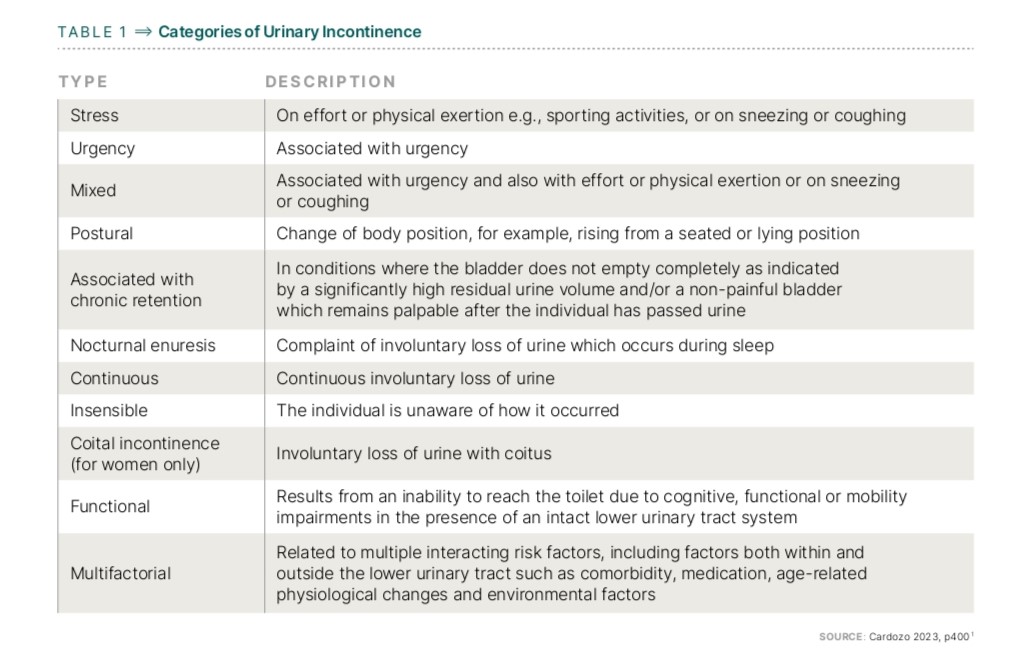
The report anchors its analysis in global prevalence data from the EPIC study, a population-based survey covering five countries. Using a prevalence rate of 8.5% applied to the current adult global population of 5.47 billion, approximately 465 million adults worldwide currently experience urinary incontinence (UI) — a figure the report treats as conservative, noting that other studies put female prevalence alone at between 25% and 45%.
That number is expected to grow. United Nations data show the global population aged 65 and over tripled from around 260 million in 1980 to 761 million in 2021, with projections exceeding one billion by 2030. Rising obesity rates compound the demographic trend: the World Obesity Federation projects 1.53 billion adults globally will be living with obesity by 2035, a condition closely linked to stress urinary incontinence. The International Diabetes Federation, separately, projects global diabetes prevalence to rise from 537 million cases in 2021 to 783 million by 2045 — and diabetes-related nerve dysfunction is a recognized contributor to bladder control loss.
The hidden burden of undertreatment
Despite its prevalence, UI remains poorly addressed through formal clinical channels. Studies from the UK, Denmark, and the US show that only 17%, 29%, and 34% of women respectively discussed their symptoms with a clinician. A 2024 systematic review identified the primary barriers as stigma, embarrassment, and the widespread perception that UI is an inevitable consequence of ageing rather than a treatable medical condition.
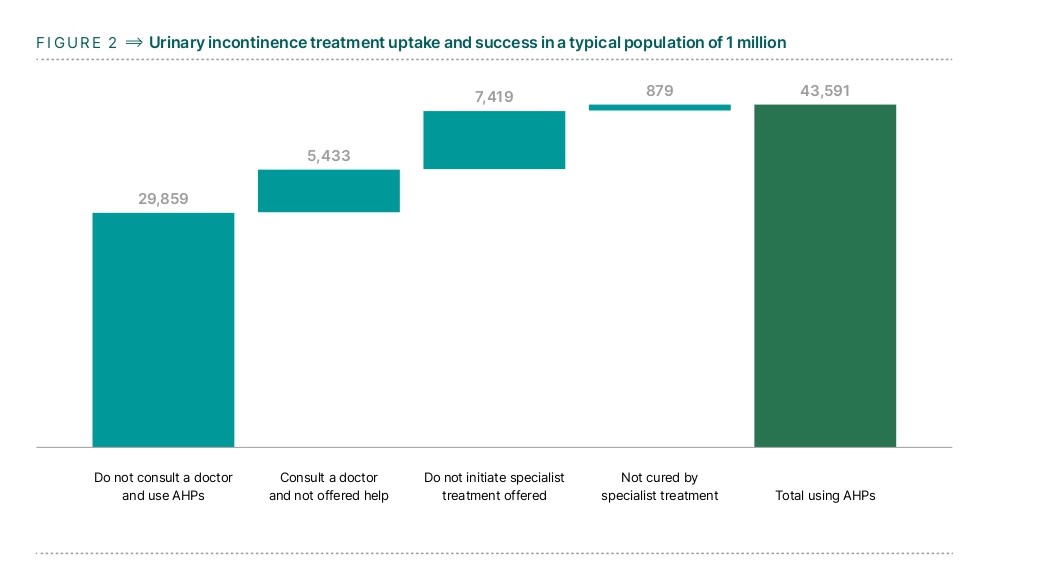
For those who do enter the clinical system, outcomes are mixed. The report models treatment uptake and success across a hypothetical population of one million adults, drawing on published cure rate data across surgical, pharmacological, and behavioral interventions. Approximately 43,500 people per million — representing 47% of those with UI — ultimately rely on absorbent hygiene products (AHPs) as their primary management tool. The largest single group, nearly 30,000 per million, are those who never consult a clinician at all but self-manage using products.
Clinical and economic value of AHPs
Absorbent hygiene products are regulated medical devices designed to defined performance standards, distinct from ad hoc substitutes such as menstrual pads or tissue products not designed to handle urine loss.
Among the clinical studies reviewed is a 2015 Thai study conducted to support the country's Universal Health Coverage Scheme. Over a ten-week period, participants using disposable AHPs experienced significant improvements in health-related quality of life and daily functioning, while the risk of pressure ulcers fell by 67%.
The report also makes a strong economic case for effective continence management. In Australia, the Continence Foundation calculated that managing UI cost the public health system AU$3.8 billion in 2023 — 1.5% of total public health expenditure — with a further AU$53.9 billion attributed to productivity losses from reduced employment, absenteeism, and lower workplace output. A 2014 US study found that employees with urgency UI had 47% greater total absence costs and 63% more absence days than colleagues without the condition.
Within that cost structure, AHPs represent a relatively modest share. A Dutch study found disposable AHPs constituted between 11% and 15% of total UI care costs. An Australian analysis, excluding productivity losses, put the figure at 18.3% for men and 17.5% for women. Public healthcare systems in the UK, the Netherlands, and Australia have each integrated continence products into official reimbursement frameworks, reflecting a consistent assessment of their value relative to the broader costs of unmanaged UI.
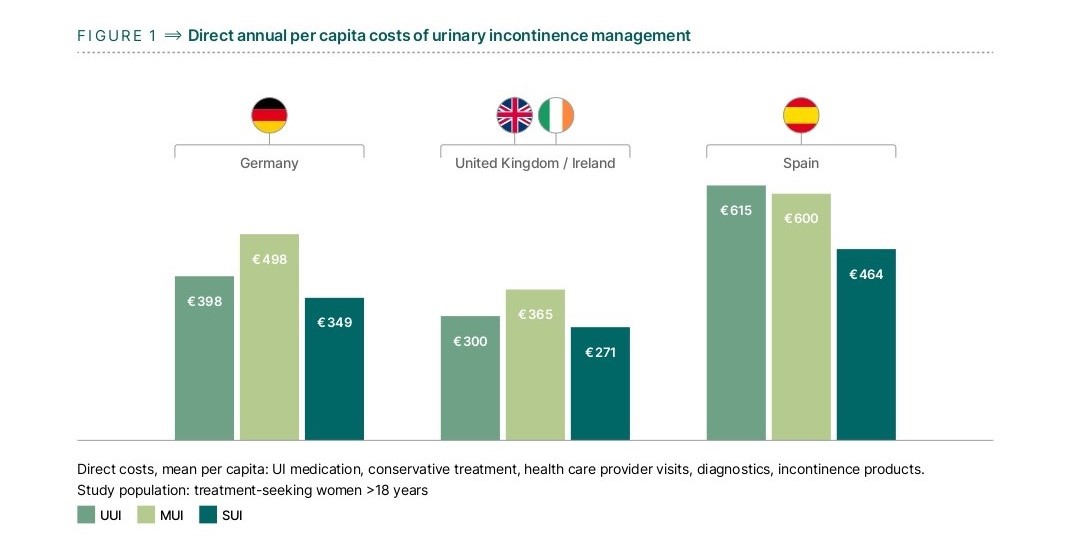
On individual product costs, a 2023 US survey found women using a mean of 1.8 incontinence products per 24 hours at a mean weekly cost of $5.42, equivalent to $282 per year — though costs rose steeply with severity, reaching $1,762 annually for the most severe cases.
Sustainability: progress and limits
The report acknowledges that disposable AHPs carry an environmental footprint while arguing that sustainability must be balanced against clinical effectiveness and quality of life. AHPs' carbon footprint is concentrated at the raw material and manufacturing stages, which together account for 50–60% of lifecycle emissions. The disposal phase represents 30–35%, meaning that product optimization at the design stage offers the greatest leverage for emissions reduction.
The sector has reduced product weight through advances in superabsorbent polymer (SAP) technology, enabling equivalent or improved absorbency with less material and consequently lower distribution and disposal volumes. A 2022 Italian care home study found that implementing person-centred continence care — matching product selection more precisely to individual needs — reduced AHP consumption by a median of 24.6% with no increase in leakage or skin health incidents.
On recycling, the report is direct about current limitations. Less than 1% of AHP waste is processed through recycling facilities. Adult UI products account for approximately 60% of the AHP waste stream in Europe, but unlike infant diapers — generated primarily in the home — adult continence products are used across care homes, hospitals, and private residences, creating a fragmented collection challenge. Mechanical separation pilots in Italy and the Netherlands have demonstrated technical feasibility but struggled with economic viability. Chemical recycling and pyrolysis remain at experimental or pilot stage. Anaerobic digestion is complicated by pharmaceutical residues and the inability of SAP to degrade under anaerobic conditions.
EDANA launched a waste-to-resource initiative in 2021 and published a companion report on the subject in 2023. Current pilot proposals include integrated collection schemes for care homes, consumer-driven registration for product waste collection, and fermentation-based recycling focused on organic component degradation and biogas production. Commercial viability will only be achieved when technology, infrastructure, and consistent demand for recycled materials converge.
The full report is available via edana.org.