Bioveld North Inc., a subsidiary of the Canadian-owned BMI Group, has welcomed a $5.1-million investment from the Government of Ontario to advance plans to restart the historic Espanola pulp mill, which has been idled since 2023.
Delivered through the Biomass Pathways Stream and Innovative Bioproduct Manufacturing and Modernization Stream of Ontario's Forest Biomass Program, the funding supports the front-end loading engineering and design (FEL) that will finalize the design and cost of the restart. Bioveld North is contributing $5.4 million to the $10.5-million engineering program.
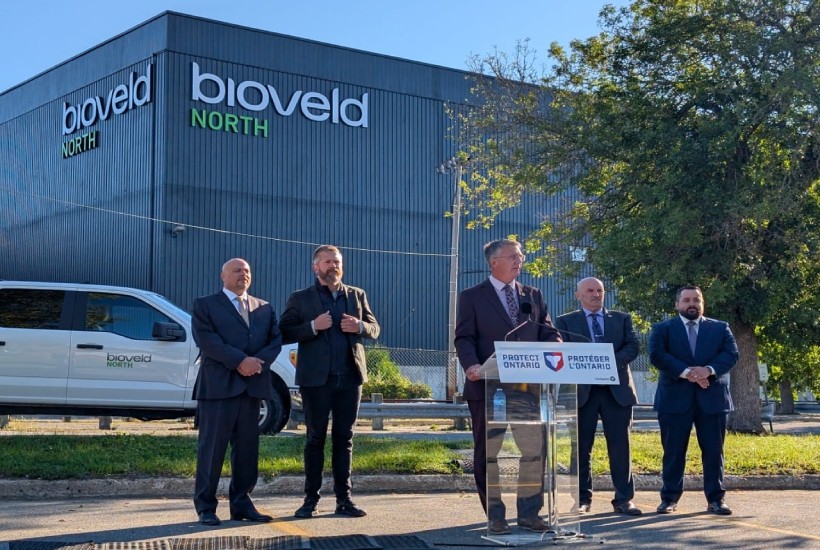
Pictured from left: Jason Collins, Corporate Development Officer, BMI Group, Paul Veldman, CEO, BMI Group, Hon. Kevin Holland, Associate Minister of Forestry and Forest Products, Bill Rosenburg, MPP, Algoma—Manitoulin, Joseph Burke, CAO, Espanola.
The company said the investment is an important step toward its goal of returning the mill to production and re-establishing Espanola as an anchor of the regional forestry economy. Bioveld North's investors, including Dutch firm Business EQ Investments, are proud to support the next generation of forestry innovation in Canada.
Bioveld North is not yet setting a timeline and will have more to say as the engineering advances and the remaining pieces come together.
Impact on the Regional Forestry Industry
For more than a century, the Espanola mill was an economic cornerstone of Northern Ontario. Its idling in 2023 cut roughly 400 direct jobs and disrupted a regional supply chain that historically supported an estimated 2,000 additional jobs across 19 Ontario sawmills, six of which relied on Espanola for approximately 75 per cent of their wood-chip sales.
"This mill has been at the heart of Espanola for generations, and its idling was felt across our whole community. Today's funding commitment from the Province of Ontario is a vote of confidence in our town's future - and in the work that Bioveld North is advancing towards a restart. A reopened mill means good jobs and families staying in Espanola." – Douglas Gervais, Mayor of Espanola.
With no domestic outlet, several sawmills have been idled, and most remaining residual fibre is now shipped out of province, weakening Ontario's forestry value chain at a time of mounting trade pressure.
Proposed Mill Restart and Production
The feasibility study for the restart explores returning the mill to approximately 800 air-dried metric tonnes per day of premium talc-free Northern Bleached Softwood Kraft (NBSK) pulp and about 180 short tonnes per day of paper for medical and food grades, with capacity to expand over time.
It is the first phase of Pulp+, Bioveld North's plan to develop the site into an integrated forest bioproducts hub, adding biocarbon, renewable fuels and clean power through phased private investment.
"This mill was never torn down or left to rot - it was kept warm, waiting. Too much was left here for us not to look at it closely and meticulously, and Ontario's investment makes that possible. Our whole business is built on a simple idea - put wood back to work. Through our Pulp+ approach, we see Espanola capturing the full value of one of the richest forest regions in the country: premium pulp and specialty papers first, then biocarbon, renewable fuels and clean power. This mill ran for more than a century. I'd like my great-grandchildren to be able to say it ran for a century more." – Paul Veldman, CEO, The BMI Group
Bioveld North acquired the former Domtar site in late 2025. Restoring domestic production of specialty pulp grades that Canada now imports would strengthen supply-chain security amid sustained tariff pressure on Canada's forest products and would demonstrate a Canadian-owned company rebuilding capacity that multinationals left behind. A successful restart will require substantial private and customer investment alongside government support.
In the months ahead, the company will work closely with mill workers, the sawmills that depend on the site, the Town of Espanola and local First Nations to build the foundation for a successful restart. Bioveld North said this groundwork, with the community and its partners, is its immediate priority.
Ontario's early-stage investment comes as the federal government has released its Forest Sector Action Plan, which identifies regional mills and bioeconomy projects as priorities for support. Bioveld North said it will continue to engage federal, provincial and private partners as it advances the project.
Quick Facts
-
Ontario is investing $5.1 million through the Biomass Pathways Stream and the Innovative Bioproduct Manufacturing and Modernization Stream of the Forest Biomass Program.
-
The funding supports a $10.5-million front-end loading engineering and design program; Bioveld North is contributing $5.4 million.
-
The engineering will finalize the design and cost of the restart; Bioveld North intends to restart the mill and will confirm timing as the work advances.
-
The Espanola mill operated for more than 120 years before being idled in 2023.
-
The mill and its supply chain historically supported roughly 400 direct jobs, an estimated 2,000 additional jobs, and 19 regional sawmills.
-
The restart would return the mill to approximately 800 air-dried metric tonnes of pulp per day, including premium talc-free NBSK, and about 180 tonnes per day of specialty paper.
Bioveld North and The BMI Group
Bioveld North Inc. is a wholly owned subsidiary of The BMI Group, a Canadian development and investment firm that specializes in acquiring and revitalizing strategic industrial assets. BMI acquired the former Domtar site in Espanola in late 2025 and brings mill-restart experience from projects in Port Huron, Michigan and the Niagara region.
Pulp+ concept is designed to retool legacy forestry infrastructure into diversified, lower carbon bioproduct platforms anchored by Canadian ownership and partnership with local communities and First Nations.